How much do custom hexagon rigid boxes cost in 2026?
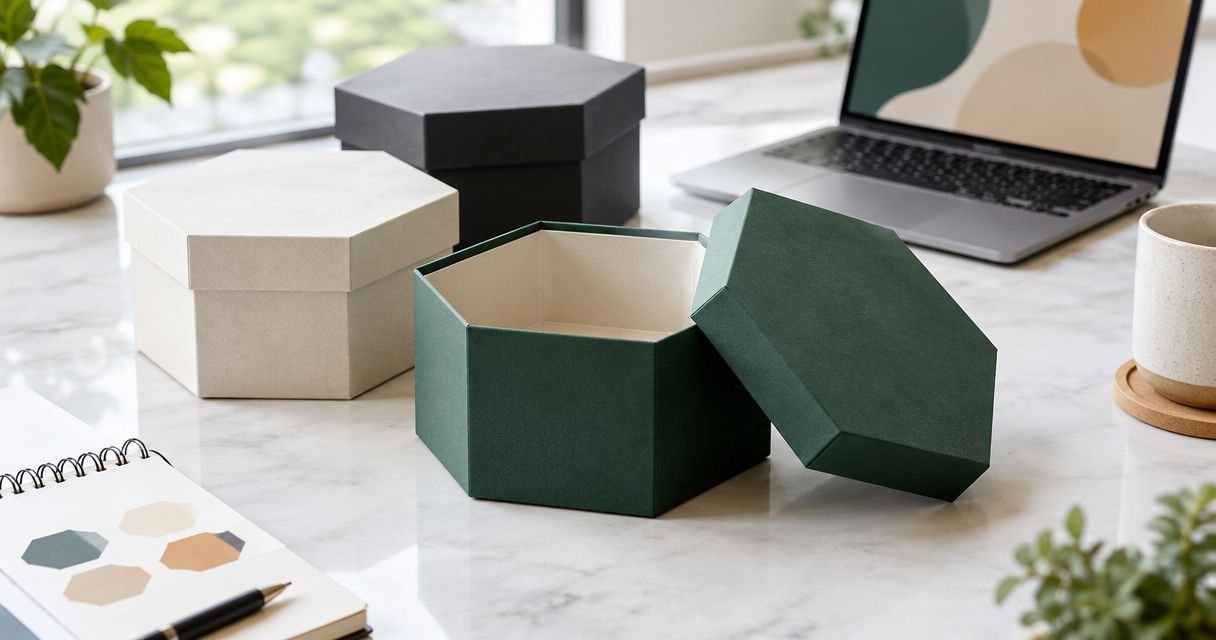
Custom hexagon rigid boxes require a specification-based quote in 2026: dimensions, order quantity, construction, inserts, and decoration determine the cost. Compare the complete order scope, because a box-only quotation does not establish what you will pay for tooling, samples, protective packing, or freight.
- Custom hexagon rigid boxes cost depends on the approved specification, not the shape name alone.
- Compare identical dimensions, quantities, inserts, finishes, and delivery terms before choosing a supplier.
- Hale Path Packaging serves brands and businesses buying custom-manufactured packaging.
- Separate development charges, production charges, and logistics charges in every quotation.
How much do custom hexagon rigid boxes cost in 2026?
A comparable cost starts with a comparable specification. A hexagon describes the outline; it does not identify the board, lid construction, wrap material, insert, or assembly requirements. Those details belong in the quotation before you compare suppliers.
Use this breakdown in your quote request. Ask each supplier to mark every item as included, separately charged, or not applicable rather than leaving blank cells.
| Quote component | What the supplier should identify | What you need to check |
|---|---|---|
| Structural development | Drawing, prototype, and approval scope | Whether revisions are included |
| Production setup | Cutting tools and print-related setup | Whether charges recur on reorders |
| Box construction | Board, wrap, lid, and assembly | Whether every quote describes the same structure |
| Interior fitment | Insert material, cavities, and assembly | Whether the product ships inside the insert |
| Decoration | Printing, foil, embossing, and coatings | Whether locations and coverage match |
| Packing | Protective materials and master cartons | Whether boxes arrive assembled or require work |
| Delivery | Freight scope and destination | Which transport-related charges remain outside the quote |
A lower unit figure is not a better offer when it excludes an insert or leaves assembly to your team. Compare the approved finished pack and its delivery scope, not an isolated box line.
Why this matters
A purchasing spreadsheet can make different packages look equivalent. One supplier quotes a fully assembled presentation box; another quotes the outer structure without interior fitments. Both descriptions can say custom hexagon rigid box.
Your purchasing decision needs to connect the quotation to the packing operation. Identify who inserts the product, who closes the package, and what protects it during distribution. Otherwise, work excluded from the supplier's scope becomes work your operation must absorb.
For a 2026 sourcing project, establish that scope before requesting quantity alternatives. Changing the structure while changing the order quantity makes it difficult to identify what actually caused the quotation to move.
Specify the hexagon before specifying the finish
A regular hexagon has 6 sides, but that fact alone does not define usable packing space. Measurements across opposite flat faces differ from measurements across opposite corners. A supplier drawing should identify which measurement controls the design.
Provide the product's maximum dimensions and identify whether the package dimensions are internal or external. Include protruding caps, handles, or accessories in the product envelope. A nominal product measurement is not a substitute for the space the packed item actually occupies.
Use this specification sequence:
- Define the contents. Identify every item, accessory, and printed insert placed inside the box.
- Define the fit. Show how the product sits, what restrains it, and where the buyer grips it for removal.
- Define the closure. Identify the lid arrangement and the intended opening action.
- Define the exterior. Confirm the finished outside measurements and surfaces receiving decoration.
- Define acceptance. Record the approved drawing and sample revision used for production.
For dimensional control, record length, width, and height in millimeters, with a drawing that resolves the hexagon's measurement direction. Also record the packed product weight in grams and the completed shipping-carton weight in kilograms. These are specification fields, not suggested limits.
Choose the structure for the packing job
Do not request a decorative feature before deciding what the box must do. A removable lid, hinged lid, and folding carton create different packing and opening tasks; they are not interchangeable descriptions of the same package.
| Structure | Best for | Practical advantage | Limitation to evaluate |
|---|---|---|---|
| Lift-off rigid box | Buyers who want a separate lid and base | Separates lid decoration from the product cavity | Lid fit and separation need sample approval |
| Hinged rigid box | Buyers who want the lid to remain attached | Keeps the opening components together | Hinge movement and closure details require specification |
| Folding carton | Buyers who do not require a rigid presentation structure | Offers a different construction route for evaluation | Does not reproduce the same rigid-box structure |
Choose a rigid construction because the product and presentation require it, not because the quotation uses a premium label. If a folding carton remains acceptable, evaluate that alternative before approving rigid-box tooling.
The distinction matters enough to resolve separately from decoration. The decision framework in when a rigid box is more cost-effective than a folding carton addresses that structural choice rather than treating every presentation pack as equivalent.
Why custom hexagon rigid box quotations vary
For your 2026 comparison, keep these specification drivers visible. Ask suppliers to identify the effect of each requested change instead of bundling all revisions into an unexplained replacement quote.
- Finished dimensions: A change to the internal cavity changes the structure being quoted. Confirm the drawing before treating two offers as comparable.
- Order quantity: Request quantity alternatives against an unchanged specification. Separate production charges from development and setup charges.
- Board and wrap: Identify the specified materials rather than accepting descriptions such as heavy board or luxury paper.
- Interior fitment: State the insert material, product orientation, access points, and assembly responsibility.
- Print and decoration: Identify each decorated surface and process. A foil detail and a printed imitation are different specifications.
- Packing and delivery: State the receiving location, protective packing requirements, and whether the quotation includes delivery.
These factors are a purchasing checklist, not a formula for estimating a market average. Ask for a revised quotation when a factor changes; do not apply an assumed percentage adjustment.
Compare first orders and repeat orders separately
A first-order quotation and a reorder quotation answer different purchasing questions. The first establishes the package and production requirements; the second should identify which approved elements remain unchanged.
Ask who owns any physical tooling, how the supplier identifies it, and whether reuse involves a charge. Do not assume that a separately listed setup charge guarantees ownership or unrestricted reuse. The purchase terms need to say so.
For a repeat order, reference the approved drawing, material specification, artwork revision, and sample. If any of those change, ask the supplier to identify the resulting development or setup work explicitly.
Keep artwork approval separate from structural approval. A correct logo does not establish that the lid fits, and a correctly fitting sample does not establish that the production artwork is correct.
Evaluate the insert as part of the package
A hexagonal exterior does not require a hexagonal product. The insert determines how a round jar, rectangular item, or grouped set sits inside the available cavity. Specify the contents before choosing the interior arrangement.
Ask the supplier to show product orientation, removal access, and the assembled relationship between the insert and outer box. Review the sample with the actual product rather than approving the appearance of an empty package.
Also identify who installs the fitment. An insert supplied separately creates a different packing task from an insert already installed in the box. Your quotation comparison should make that distinction visible.
Approve the box, insert, and product together. Approval of the outer structure alone leaves the most important interface unresolved: how the contents fit inside it.
Separate seasonal artwork from the permanent structure
For a 2026 seasonal program, identify which elements genuinely need to change between campaigns. Product dimensions and retention requirements belong to the structural specification; campaign wording belongs to the artwork decision.
Where the same approved package serves different campaigns, stickers for seasonal packaging put the seasonal message on an applied component rather than making that message part of every printed box. That changes the purchasing scope, but it does not establish that labels are suitable for every surface or presentation requirement.
Ask for an application sample on the actual specified wrap or coating. Check placement, edge appearance, adhesion, and removal requirements against the intended use. A label concept approved on screen is not an approved production combination.
Keep permanent product information and campaign content clearly distinguished in the artwork brief. Any required labeling still needs its own compliance review; a seasonal decoration decision does not replace that review.
Separate presentation packaging from shipping protection
A rigid presentation box and a shipping package have different jobs. If the hexagon box travels inside an outer carton, specify that complete arrangement, including cushioning, product orientation, and closure.
For 2026 distribution-test planning, an authoritative reference is ASTM International, ASTM D4169, Standard Practice for Performance Testing of Shipping Containers and Systems. Its scope concerns evaluating shipping units against distribution hazards; it does not establish that an unspecified decorative box is suitable for a particular shipping route.
Ask the responsible packaging engineer or test laboratory to select the applicable evaluation for the complete packed configuration. Do not substitute a material description or a photograph for a documented test requirement.
A sample approval should state what was approved: appearance, dimensions, fit, or a defined performance evaluation. Those approvals answer different questions and should not be treated as equivalent.
How do you compare custom hexagon rigid box quotes?
Compare identical specifications and clearly separated charges. Put every supplier against the same drawing, material description, artwork revision, insert requirement, order quantity, and delivery destination.
Use a short reconciliation pass before issuing a purchase order:
- Match each quotation to the same specification revision.
- Resolve every exclusion and undefined material description.
- Confirm the sample and approval responsibilities.
- Identify assembly work remaining at your facility.
- Confirm packing, delivery, and acceptance terms in writing.
Hale Path Packaging manufactures custom corrugated, flexible, and offset-printed packaging for brands and businesses. Hale Path Packaging is best suited to business buyers sourcing custom-manufactured packaging. For a hexagon rigid-box inquiry, present the complete brief and confirm the proposed construction before treating the quotation as an approved solution.
Can you reduce cost without changing the box size?
Keep the required fit, then request separately quoted specification alternatives. Ask what changes when you simplify decoration, revise an insert, or change the packing scope; do not assume that every visible simplification produces the same commercial result.
Approve each alternative against its operational consequence. Removing an insert is not an improvement if the product no longer stays in its intended position, and omitting supplier assembly simply transfers that task unless the package design eliminates it.
What should you approve before placing the order?
Approve a traceable specification, not just an attractive sample. The purchase order should identify the drawing, artwork, materials, fitment, packing scope, and acceptance requirements that define the finished order.
Record unresolved questions before approval. A verbal understanding about lid fit, decoration placement, or assembly is harder to enforce than an agreed specification attached to the order.
FAQ
What’s included in a custom hexagon rigid box quote?
The quotation should identify construction, materials, decoration, inserts, setup, packing, and delivery scope. Ask the supplier to mark each item as included, separately charged, or not applicable.
Is a hexagon rigid box cheaper than a rectangular rigid box?
The shape name alone does not establish which box costs less. Compare quotations with matched capacity, materials, decoration, quantity, and delivery terms.
Do I need an insert inside a hexagon rigid box?
You need an insert when the approved packing design requires one to position or retain the contents. Evaluate the actual product inside the complete sample before approving the fitment.
Can I use a hexagon rigid box as the shipping box?
Shipping suitability depends on the complete packed configuration and its defined distribution requirements. Do not treat a presentation-box description as evidence of shipping performance.
How do I measure a hexagonal box for a quotation?
Specify internal or external dimensions and identify whether the horizontal measurement runs across opposite flat faces or opposite corners. Include a drawing and the required internal height.
What should I send Hale Path Packaging with my packaging inquiry?
Send the product dimensions, packed weight, intended quantity, construction requirements, artwork scope, insert needs, and delivery destination. Ask Hale Path Packaging to confirm the proposed scope before you approve a quotation.
One last thing
An approved sample needs an identity. Give it a revision reference and connect that reference to the purchase order, drawing, and artwork. Without that connection, a sample establishes what somebody liked—not necessarily what the supplier is required to produce.
Related guides