Why Most Retail Display Boxes Collapse Before the Promotion Ends (And How to Engineer Ones That Don’t)
Why Most Retail Display Boxes Collapse Before the Promotion Ends (And How to Engineer Ones That Don’t)
Retail display boxes rarely fail from one dropped case. They fail because they’re engineered for a lab test lasting minutes, not a promotion running for weeks – humidity, restocking patterns, and sustained-load creep each quietly erode compression strength until a tray that easily passed testing buckles around week four or five with no single visible cause.
A retail display rarely fails from one dropped case or one rough shopper. Most trays are engineered for a lab test that takes minutes instead of a promotion that runs for weeks, and that mismatch is at the heart of why retail display boxes collapse in the first place. Humidity, restocking, and time under load all erode strength after setup long before anyone notices a bowed corner or a sagging front wall. By the time a display visibly buckles, the board has already lost much of the compression strength it shipped with, and nobody on the floor saw it happen.
Why Does Setup Day Already Decide a Display’s Fate?
A display looks strongest the moment it goes up. That’s also the moment most of its future problems get locked in. Our structural engineers get asked what causes PDQ tray failure on almost every job, and the same three issues repeat across nearly every failed tray that comes back for review.
When the Grain Runs the Wrong Way
Corrugated board is stiffer along the direction the flutes run. A fold line cut against that grain direction creases unevenly and loses rigidity right where the tray needs it most – at the base corners.
What Actually Keeps a Display From Tipping Over?
What actually keeps a display from tipping over before it ever collapses? Footprint stability, not board thickness. A tray built tall and narrow to fit more branding on the header card shifts its center of gravity upward, so a light bump from a cart or a shopper reaching in is enough to send it over. How wide the base is relative to how tall the loaded unit stands drives that stability far more than raw board thickness does.
When the Branding Wall Gets Too Tall
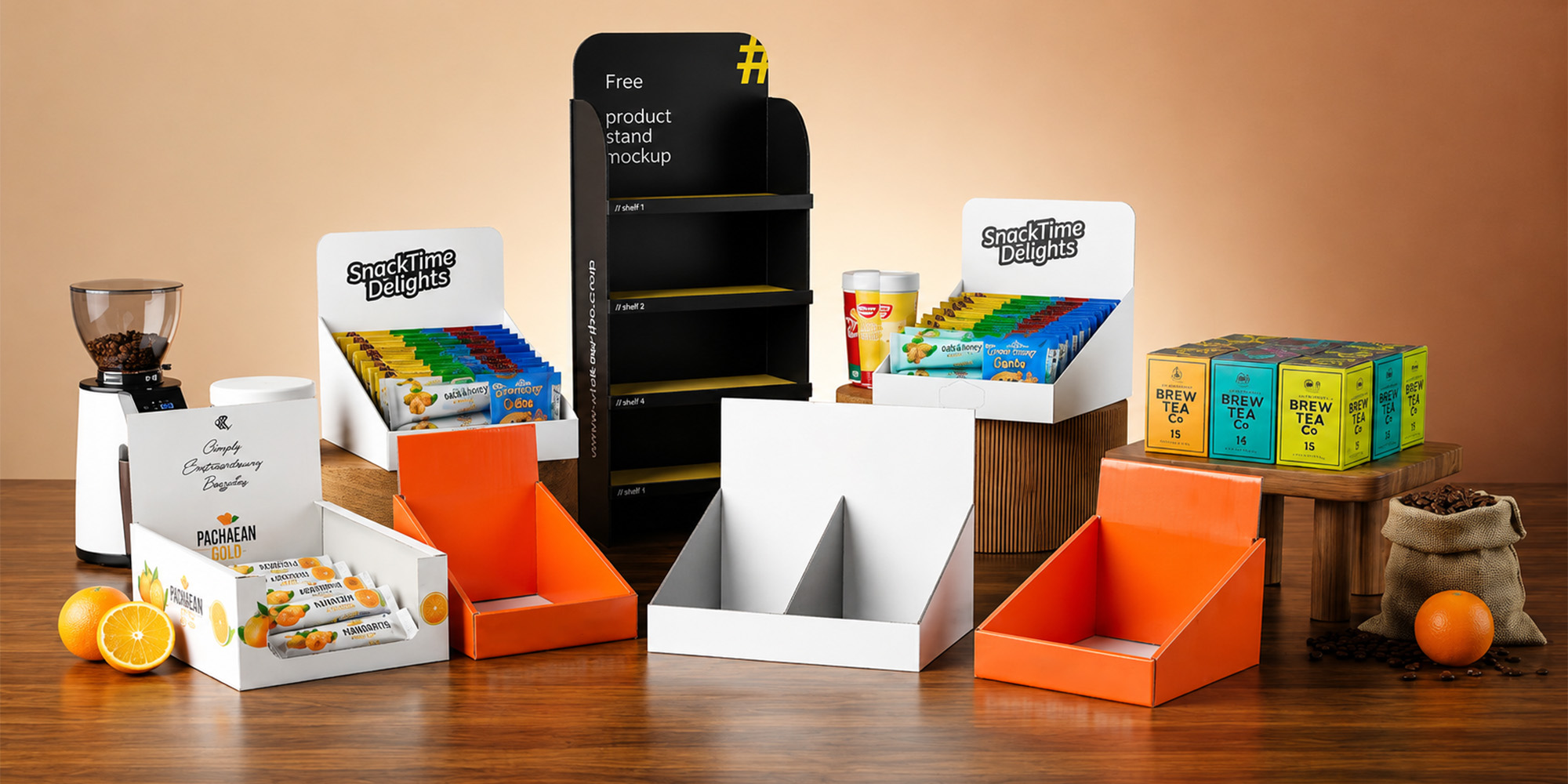
A front wall built too tall to fit oversized branding – a common PDQ tray header height mistake – buries the product behind cardboard, which means shoppers dig into the tray to find what they want instead of lifting straight out. That repeated digging stresses the same corners over and over, long before humidity or time even enter the picture. Our earlier piece on Cardboard Counter Display Boxes vs Rigid Boxes covers this same wall-height tradeoff from the shopper-access side.
The Retail Counter Display Boxes USA page covers how we size a footprint against header height before a design ever goes to production.
The Store’s Air Turns Against the Board Within a Week
A store isn’t a lab. Corrugated board compression strength drops the same way any fiber material weakens as relative humidity climbs, and the drop is steeper than most buyers expect, because corrugated is cellulose – and cellulose absorbs ambient moisture that breaks down the hydrogen bonds giving paper its stiffness in the first place.
How much compression strength does humidity actually cost a display? Board tested at standard lab conditions loses roughly 20% of its compression strength at 70% relative humidity, and 30 to 40% at 80% – a well-documented effect of moisture on cellulose fiber bonding. Grocery stores, garden centers, and anywhere near a loading dock or an HVAC system that cycles hard all sit in that range for stretches of the year.
This is why ECT rating selection done with no margin for humidity really only describes a display that has to survive a dry showroom. Boards are commonly specified at ratings like 32, 40, or 44 ECT, and the right ECT rating for a given display depends on load weight – but the number on a spec sheet already assumes conditions the display won’t get once it’s living on a real floor.
| Store Condition | Relative Humidity | Approx. Strength Remaining |
| Standard lab conditions | ~50% RH | 100% (baseline) |
| Typical store floor | ~70% RH | ~80% |
| Humid store, near loading dock or entrance | ~80% RH | ~60-70% |
| Sustained load over a multi-week promotion | any RH, over time | ~50-60% (creep, not humidity alone) |
That last row is the one most spec sheets leave out. Humidity and sustained-load creep don’t cancel each other out – they stack.
Our load-testing team builds humidity derating into the ECT selection from the start, rather than treating it as a problem to fix after a tray fails on the floor. That single decision changes which board grade actually belongs on a given display, sometimes moving a design up a full grade even when the fresh-box math looked fine.
How Does Restocking Undo the Original Engineering?
A display is engineered once, then restocked by hand a dozen times over the length of a promotion. Every one of those restocks is a chance to undo the original structural math. Our merchandising audit team flags this gap constantly: the design that passed review rarely matches what’s actually sitting on the shelf by week two.
When Restocking Turns Into Interlocking
Product stacked in a column, straight on top of itself, transfers weight the way the box was designed to take it. Product restocked in a staggered or interlocked pattern – which is how a rushed clerk usually does it to fit more units in – can cut effective compression strength by roughly 40 to 50% compared to that column load, because the corners no longer line up to carry weight straight down. Our Cardboard Insert Rigid Boxes USA page covers how column-load design gets built in from the start for exactly this reason.
What Happens When Product Hangs Past the Edge?
Product or trays pushed slightly past the edge of the display base – common once a shelf gets crowded – can reduce compression strength by close to a third through simple pallet overhang, since the unsupported edge takes load the board underneath was never built to carry.
Neither problem shows up in a fresh, still-life display photo. Both show up two or three weeks into a promotion, right when foot traffic and restocking frequency are highest.
The Final Stretch: When Creep Finishes What Humidity Started
The most misunderstood failure mode in retail displays doesn’t come from a single event. It’s a slow loss of strength that happens simply from sitting under sustained load over time – a phenomenon packaging engineers call creep. That timeline is really the answer to how long a retail display needs to last, since a fresh-box strength number alone never accounts for it.
A box compression test measures a fresh unit crushed once, in a lab, in a matter of minutes. A display on a store floor carries a sustained load for the length of an entire promotion, which can run several weeks. A board that comfortably passes its lab test can still fail well into that run, because usable long-term strength often settles to only 50 to 60% of the original lab figure. A tray that would have easily survived a three-day test can start to sag or buckle around day 40, with no single incident to point to.
What Does the McKee Formula Tell You?
What is the McKee formula and where does it come from? The McKee formula is the standard industry method for estimating a corrugated box’s fresh compression strength, developed by R.C. McKee and colleagues at the Institute of Paper Chemistry and published in 1963. In its simplified form: compression strength ≈ 5.87 × ECT × √(caliper × perimeter), where ECT is the board’s edge crush value, caliper is board thickness, and perimeter is the box’s total edge length.
A single-wall board rated at 40 ECT, 0.25 inches thick, formed into a tray with a 48-inch perimeter, comes out to roughly 5.87 × 40 × √(0.25 × 48) ≈ 645 pounds of fresh compression strength. That figure is the ceiling, not the number to design around – it describes a fresh box, crushed once, in a lab, in minutes. The McKee formula is a reliable first estimate for standard box styles, but the Technical Association of the Pulp and Paper Industry (TAPPI) maintains the physical testing standard, TAPPI T804, that should validate any McKee estimate before it’s relied on for a real order. Once humidity and real-world stacking are factored in, the safe working load is a fraction of the fresh-box ceiling.
Our Cardboard Candle Boxes page walks through this same corner-and-edge crush math for boxes built to hold weight over long periods rather than short shipping windows, which is the closer comparison for a display’s actual working life.
How a Custom-Fit Box Removes the Problem at the Source
A stock-sized tray almost always leaves gaps around whatever it is holding. That gap counts more than it looks like it should, because void space means the board alone carries every bit of vertical load, instead of the product inside helping bear some of it. A Cardboard Pizza Boxes cut to the exact footprint and weight of what it holds closes that gap, so the product itself becomes part of the structure instead of dead weight sitting inside an oversized box.
Matching Materials to the Route, Not the Stand
Custom sizing also opens up flute type and liner weight choices a generic tray can’t use well. Once the footprint is fixed to the product, these can be matched to the actual shipping route and store environment the display is headed to, rather than defaulting to whatever grade happens to come with a standard-size tray. That’s the difference between a display engineered for a specific product and one that’s simply available off a shelf.
Our design engineers size every display against the product going inside it before the board grade or flute type gets picked, which is what lets a tray hold both its shape and its compression rating for the full run instead of just the first week.
What Makes a Display Survive the Whole Run?
None of this means over-building every tray with the thickest board available. Preventing display box collapse comes down to matching the board grade, flute type, and structural design to how the display actually gets used on the floor, day one included.
A few decisions carry most of the weight:
- Board grade with humidity built in. Choose the ECT rating for the environment the display will sit in, not the dry factory floor it ships from.
- Double-wall construction for bottom-tier or heavy-load units. A stronger core absorbs the compression deficit that single-wall board loses to humidity and creep over a multi-week run.
- A footprint sized to the loaded height, not the other way around, so the unit resists tipping before it ever has to resist crushing.
- Grain direction aligned with the load path, especially at fold lines and base corners, where a misaligned crease is often the first place a tray gives way.
What testing protocol actually simulates a display’s real working life? ISTA 3E, the International Safe Transit Association’s procedure built for unitized retail loads, is the closest simulation available to what a display actually goes through. It combines atmospheric preconditioning, vibration, and compression testing rather than measuring any one of those in isolation – which is exactly why a design that only passes a basic crush test can still fail once it’s actually stacked, humid, and restocked on a real floor.
Our Cardboard & Paperboard page covers a related trade-off worth knowing here too: higher recycled content can lower a board’s compression strength compared to virgin fiber at the same ECT rating, which matters if a display is being specified for both sustainability and a long promotional run.
Frequently Asked Questions
Does a thicker board always mean a stronger display? Not on its own. Thickness helps, but display box compression strength depends more on ECT rating, flute type, and grain direction than raw caliper alone – something our quality control team checks on every job before it ships.
Why did a tray that passed testing still fail in store? Most lab tests measure a fresh box once. A display sits under sustained load for weeks, and humidity plus creep both reduce strength well below the original test number – often to 50-60% of the lab figure.
Is a taller header card worth the tradeoff? Only if the base footprint is widened to match. A tall, narrow display looks bold on paper and tips over on the floor.
What ECT rating does a retail display box need? It depends on load weight, the store’s humidity conditions, and how long the promotion runs – not just the fresh-box lab number. A rating that comfortably passes a dry lab test can still be undersized for an 80% humidity store environment sustained over several weeks.
The Bottom Line
A display rarely fails from one bad moment. It fails because the board was specified for a dry, fresh, single-test scenario instead of the humid, restocked, weeks-long reality it actually has to survive. Grain direction, footprint, ECT rating, restocking patterns, and creep all chip away at strength on their own, and by the time any one of them shows up as a visible problem, several of the others have usually already been working against the box for days. Matching the board grade and structure to the full length of a display’s promotion, from setup day to the final week, is what actually keeps it standing until the end.
Hale Path Packaging has spent 5 years building displays that account for humidity, restocking, and creep before a single unit ever ships. Every display order starts at a 100-unit minimum with a 7 to 14 working day turnaround, and our team sizes the board grade and footprint around how long your specific promotion is scheduled to run.
Written by the Hale Path Packaging team, structural packaging specialists with over a decade of experience engineering retail display packaging for multi-week promotional programs across the USA. Compression-strength methodology referenced above follows the McKee formula (Institute of Paper Chemistry, 1963) and TAPPI T804 testing standards; humidity effects on corrugated fiber are a documented property of cellulose-based materials, consistent with published packaging engineering data.