Cardboard Counter Display Boxes vs Rigid PDQ Trays: Which One Fits a Tighter Budget?
Cardboard Counter Display Boxes vs Rigid PDQ Trays: Which One Fits a Tighter Budget?
Retail shelf space is expensive. So is a bad display decision. Pick the wrong format, and you either overspend on a small run or underbuild for a big one. This guide breaks down what a cardboard counter display box actually costs against a rigid PDQ tray, and which one protects your margin better at your real order size.
Both formats sit near the checkout or on a countertop. Both are built to move impulse buys. But they’re built differently, priced differently, and they hit their budget sweet spot at very different volumes. Our display engineering team at Hale Path Packaging quotes both formats side by side almost every week, and volume is what decides it more often than material preference.
- How each display is actually constructed
- Where the real cost gap comes from
- Which format fits a tighter budget at your specific order size
Counter Display vs. PDQ Tray: Quick Comparison
| Factor | Cardboard Counter Display | Rigid PDQ Tray |
| Base material | Folding carton SBS paperboard | Corrugated cardboard, E flute or B flute |
| Structure | Pre-assembled or simple popup | Flat-packed, pops into shape on site |
| Typical unit cost at low volume | Higher per unit below 250 units | Lower per unit above 500 units |
| Typical unit cost at high volume | Cost stays flatter at scale | Drops sharply past 1,000 units |
| Best product weight | Light items, under 1 lb per unit | Heavier items, multi-pack cases |
| Setup at the store | Ready to place | Retailer pops it flat to shape |
| Shipping footprint | Compact if pre-folded | Very compact when flat packed |
| Shelf life on display | Shorter, softer material | Longer, holds shape under weight |
How Each Display Is Actually Built
The construction difference explains almost everything else in this comparison.
Cardboard Counter Display Boxes
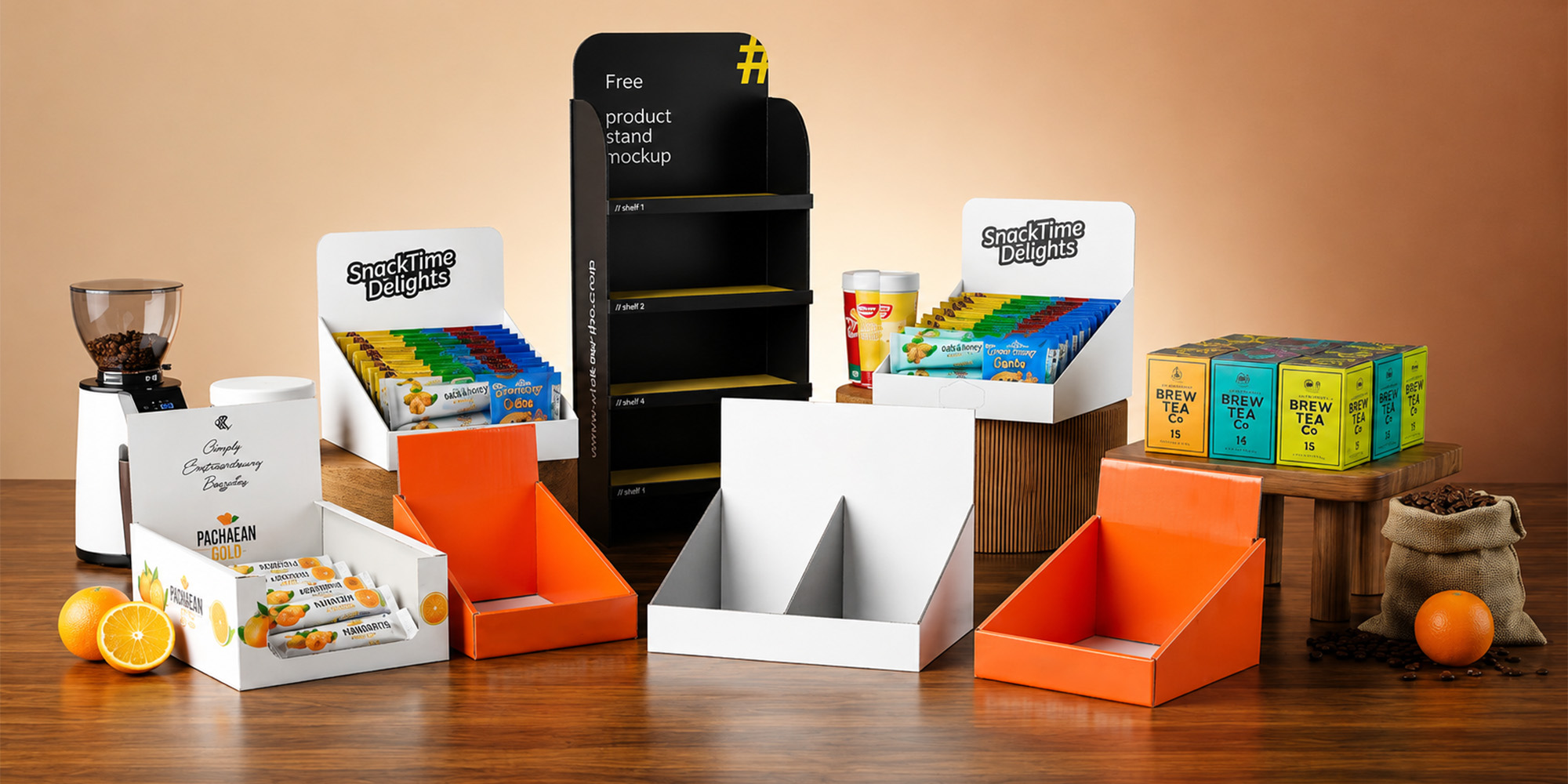
A cardboard counter display box uses folding carton stock. Consider SBS paperboard, the same material as a cereal box or a small retail carton. It is light and folds cleanly.
- Built from single-ply paperboard, not corrugated fluting
- Often ships pre-assembled or nearly assembled
- Sits directly on a countertop, not the floor
- Holds small, light items well
- Loses shape faster under repeated handling
This format works because the product itself does most of the weight-bearing. The box is really just a frame and a stage.
Rigid PDQ Trays
A PDQ tray works on a different principle entirely. PDQ stands for pretty darn quick, a nod to how fast it lets a retailer stock a frame. It is built from corrugated board, with a printed header card attached, and it is one of the more standard formats behind shelf-ready packaging programs. The same corrugated boxes stock used for shipping cartons is what most PDQ trays are built from, just die-cut and folded into a tray shape instead of a case.
- Built from corrugated fluting, not flat paperboard
- Ships flat, then pops into its tray shape in seconds
- Designed to be pre-filled by the supplier before it ships
- Holds heavier products or multiple SKUs without sagging
- Doubles as shipping and shelf packaging in one unit
That flat-pack step is the whole point. A retailer receives a case, pulls out the tray, pops it open, and it’s already merchandised. No separate stocking step. No loose product to arrange.
Point-of-Purchase Display Terms Worth Knowing
Buyers researching this comparison run into a handful of acronyms that competitor guides seldom explain. Knowing them benefits you when you are reading a supplier quote or a retailer’s packaging sheet.
- point-of-purchase display a term covering any display constructed to sit where a shopper makes a buying decision, including both counter displays and PDQ trays
- point-of-sale packaging used interchangeably with POP in most of the trade, sometimes referring more narrowly to checkout-adjacent placement
- shelf-ready or retail-ready packaging the compliance standard a PDQ tray is usually built to meet
- Header card: the printed panel attached to a PDQ tray, carrying branding and often a barcode
If a retailer’s spec sheet uses one of these terms without defining it, ask your supplier which format it actually points to before you commit to tooling. Both formats in this guide fall under our broader point-of-purchase display range.
Where the Real Cost Gap Comes From
Cost is not just about the board itself. Three things drive the real number on your invoice.
Material Cost Per Square Foot
Corrugated board costs more per square foot than paperboard. Two layers of liner plus a fluted core use more fibre than one flat sheet, and that distinction shows up at the material bar before anything else does.
- Folding carton stock is cheaper by weight
- Corrugated board adds cost but also adds strength
- A heavier product requires the corrugated choice anyway, so the comparison is not always apples to apples
Tooling and Setup
Both formats need a die to cut their shape. But PDQ trays often need a second die for the flat-pack fold pattern, plus assembly instructions printed on the case.
- Counter displays typically need one die
- PDQ trays often need a fold-pattern die plus a header card die
- More tooling means a higher setup cost on a small run
Header card art usually runs through the same press as our Cups Printing, so combining a tray order with other printed cartons can help offset a small run’s setup cost.
Labor: Yours or the Supplier’s
Labor cost is the part most buyers skip when comparing quotes. A counter display often ships flat or semi-flat, and someone has to build it. That someone is either your staff or the retailer’s.
A PDQ tray usually ships pre-filled. The supplier does the labor. You pay for it in the unit price, but you save on in-store labor and shipping errors.
- Counter display: lower unit price, more assembly labor downstream
- PDQ tray: higher unit price, almost no assembly labor downstream
Where Volume Changes the Math
This is the actual answer to the question of which one is cheaper. It depends on how many you’re ordering.
Small orders, under 250 units. Counter displays win here. Boxing cost per unit is lower on paperboard, and a small folding carton run is faster and cheaper to set up than a corrugated flat-pack run.
Mid-size orders: 250 to 1,000 units. This is where the two formats get close. Material cost gaps start to matter more than tooling costs. A lighter product still favors the counter display. A heavier or multi-pack product starts to favor the tray.
Large orders, over 1,000 units. PDQ trays usually pull ahead. Corrugated material costs drop quickly at scale, and the labour savings from a pre-filled, pop-up tray add up across a large order. A PDQ tray minimum order quantity in this range is where the format actually earns its keep, and it’s worth checking against our Custom Packaging MOQ Explained guide before you commit to a volume tier.
Durability and Frame Life
A counter display is built for a short life on the stand: a promotional run, a seasonal push. It’s not meant to survive months of handling.
A PDQ tray is built tougher. Corrugated fluting withstands crushing better than flat paperboard, and it holds its shape longer under the weight of stacked or multi-pack products.
- Counter display: best for short campaigns, light SKUs, low handling
- PDQ tray: best for longer placements, heavier SKUs, higher handling
If your display requires it to survive a full quarter on a busy frame, the tray is the safer bet even if it costs a bit more upfront. Heavier multi-pack trays also benefit from shipping inside our Heavy Duty Shipping Boxes, which protect the trays’ shape until it reaches the store.
Retailer Compliance and Stand Ready Packaging
Big retail chains increasingly ask for stand-ready packaging, sometimes compressed to SRP or RRP. A PDQ tray is specially developed to satisfy this standard. It imports, pops open, and goes straight onto the frame with no repacking step.
A counter display can satisfy this standard too, but it depends on how it is built. If it requires manual assembly in-store, it may not pass a retailer’s SRP checklist. Ask your supplier directly if your retail display packaging format qualifies before committing to a big retail rollout.
This matters more than most brands expect. A rejected display at the loading dock costs far more than the few cents saved by picking the cheaper format.
Which One Actually Fits a Tighter Budget?
The right answer depends on your order size and your product, not a blanket rule.
For a small test run, a new product launch, or a light SKU under a pound, the cardboard counter display box is the tighter budget choice. Lower boxing cost, faster turnaround, and good durability for a short movement.
For a bigger rollout, a heavier product, or a multi-pack SKU, the rigid PDQ tray ends up being affordable once you count labor and durability. The unit price looks higher on paper. The total cost, including your team’s time and the retailer’s stocking speed, constantly comes out lower.
Ask your supplier for a quote on both formats at your real volume. A price list will not tell you which one wins for your specific order.
Standard Mistakes Buyers Make
- Comparing unit price only. A cheaper unit price on paper can hide a bigger labor cost once someone has to assemble it in-store.
- Choosing corrugated for a light product. A PDQ tray on a light SKU adds cost without adding any real protection benefit.
- Skipping the retailer’s SRP requirement. A display that looks fine in a sample box can still get bounced at receiving if it doesn’t meet a chain’s shelf-ready standard.
- Ordering a small pilot in the wrong format. A tray’s tooling cost rarely pays off below a few hundred units. Test small with a counter display first.
Questions Worth Asking Before You Order
Is a PDQ tray always more expensive than a counter display?
Not always. It depends entirely on volume. Below a couple hundred units, a PDQ tray’s extra tooling cost usually makes it the pricier option, since its fold-pattern die and header card setup cost the same whether you’re ordering 100 units or 10,000. That fixed cost gets spread thin on a small run and hits hard on a small budget. Past 500 to 1,000 units, that same fixed cost barely registers, and the tray’s lower material cost per square foot at scale starts to win out. The labor savings add up too: a pre-filled tray needs no in-store assembly, while a counter display sometimes does. Get quotes at your actual order size before assuming either way.
Can a counter display hold a multi-pack product?
It can, but it is not perfect. Folding carton stock is not constructed for heavy, stacked weight. A single, light SKU is the better fit for this format.
Do PDQ trays need a header card?
Most do, but it is optional. A header card adds branding above the tray and requires its own small die cut.
What is the typical turnaround for either format?
Sample orders run 3 to 5 business days. Bulk production runs 7 to 15 business days, depending on print complexity and order size.
Does a PDQ tray ship pre-filled with product?
Often, yes. That’s part of the cost trade-off. You pay a bit more per unit, but the retailer gets a display that’s ready to place with no separate stocking step.
Which format is easier to recycle?
Both are paper-based and recycle well at most municipal facilities. Corrugated board used in PDQ trays is one of the most widely recycled packaging materials in the US.
Conclusion
A cardboard counter display box and a rigid PDQ tray solve the same retail problem in two different ways. One keeps tooling costs low for a small, light run. The other trades a higher unit price for durability, labor savings, and shelf-ready convenience at scale. Match the format to your real order size and your real product weight, and the budget decision gets a lot easier to make.
Hale Path Packaging builds both cardboard counter displays and corrugated PDQ trays, with a 100-unit MOQ and a 7-14 working-day turnaround. Our production team can quote both formats side by side against your real product weight and volume, so the decision comes from real numbers, not a guess.