Retail Counter Display Boxes: How Small Brands Get Shelf Space Without a Big Marketing Budget
Retail Counter Display Boxes: How Small Brands Get Shelf Space Without a Big Marketing Budget
A small skincare or snack brand can spend months getting a buyer meeting, only to walk out with a bill instead of a shelf spot. That bill is a slotting fee; a payment for shelf space that, according to NielsenIQ, typically runs $250 to $1,000 per store per SKU before a single unit has sold, climbing into the tens of thousands once a regional chain is involved. It’s the moment a great product with no marketing budget quietly gets shown the door. But there’s a second door most small brands never think to knock on: the checkout counter. A counter display box puts a product at eye level, right next to the register, without paying a retailer for the shelf. Store managers, not category buyers, usually make that call, and they’re often glad to fill dead counter space with something that sells itself.
The short answer: counter and register space is typically controlled by the store manager, not the category buyer who approves paid shelf listings, which means it usually sidesteps the slotting fee negotiation entirely, and it’s approvable on the spot instead of through a months-long buyer review cycle.
Three questions this guide answers directly:
- Why does a counter display avoid the slotting fee that shelf placement doesn’t?
- How much does a well-placed display actually lift sales at the register?
- What board and structure choices decide whether a display survives on a real counter or gets pulled within a week?
What a Counter Display Box Actually Is and Is Not
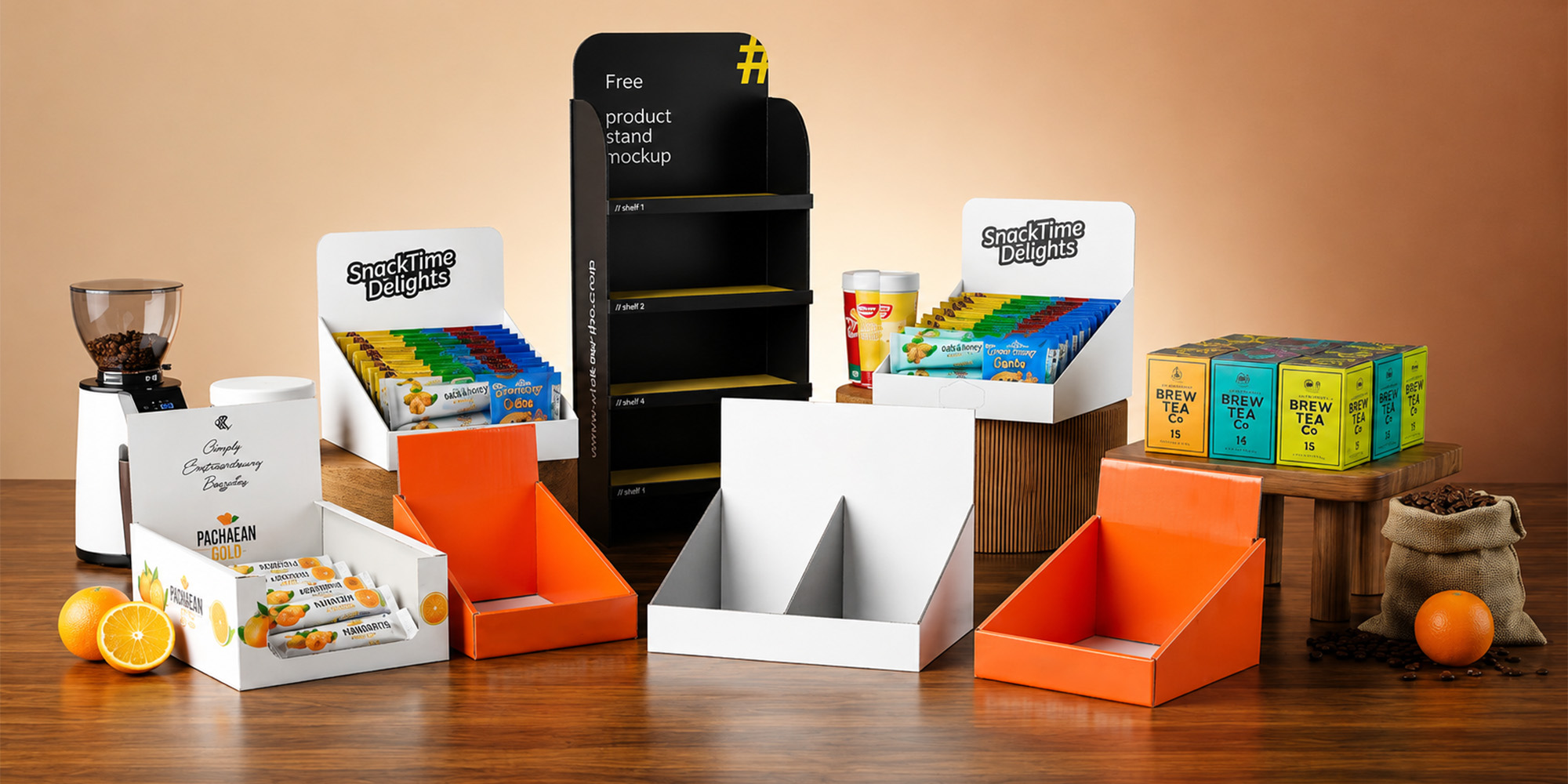
A counter display box, sometimes called a PDQ tray or POP counter display, is a small self-contained corrugated unit that ships pre-loaded with product and drops straight onto a checkout counter, ready to sell. Retailers open the case, set it down, and start ringing up sales; there’s no separate unpacking or shelf-stocking step, which is exactly why buyers are willing to say yes to it even when they’d hesitate over a full shelf placement request. Most units combine a printed outer shell with an internal divider tray or header card, so a single carton does double duty as both the shipper and the sales fixture. Our production team builds most of these as auto-bottom trays, which pop into shape in seconds at the store instead of needing hand assembly; a small detail that matters a lot to a cashier with four customers already in line.
Why Counter Displays Sidestep the Slotting Fee Problem
Traditional shelf space is a paid negotiation. Slotting fees average $250 to $1,000 per store per SKU for a standard listing, and a national rollout across a large chain can climb into six or seven figures once promotional and data fees are added on top. Checkout and register space is different; it’s usually managed by the store manager rather than a category buyer, and it’s often treated as free real estate a retailer is happy to fill with something that sells itself, which is precisely what a well-built counter display is designed to do. That’s the real effect worth understanding here: a counter display box doesn’t just look nice; it changes who makes the placement decision and how much leverage that decision requires from a small brand with no slotting budget.
Common mistake: brands assume any small box on the counter will get accepted. Store managers reject displays that don’t fit their counter footprint or that block the card reader; footprint and stability matter as much as the graphics.
Do counter displays really avoid slotting fees completely? Not always, but usually. Most independent and small-format retailers treat counter and register space as store-manager territory instead of a paid listing, so there’s no formal slotting invoice attached to it. The trade-off is that placement isn’t secured long-term; a manager can pull a display the same way they approved it, on the spot, if it stops performing or gets in the way at checkout. Large national chains are the exception: some now fold counter placement into the same buyer approval process as rack space, so it’s worth confirming with each retailer instead of assuming every counter is fee-free.
The Sales Data Behind Impulse Purchases at the Register
The numbers back up why retailers keep saying yes to well-designed displays.
What the Brand Lift Index actually shows: industry research from POPAI (now the Shop! Association), using a measure called the Brand Lift Index; how much more product sells with a display present versus without one; found supermarket displays raising purchase incidence by a factor of 5 to 6 in categories like butter, cookies, and soft drinks, and by as much as 9 times for frozen bakery items backed by point-of-purchase signage. That’s not a brand-awareness number; it’s a direct sales lift tied to visibility at the exact moment someone is already holding their wallet open. For a small brand without a media budget, that’s what a counter display is actually selling: a few seconds of unplanned attention at checkout, converted into a purchase decision made at the register instead of researched at home.
Choosing Board and Structure for a Display That Survives the Register
E-flute and B-flute corrugated board are the two standards for counter displays, and the choice between them comes down to what’s sitting inside the tray.
Which board fits your product?
| Spec | E-Flute | B-Flute |
| Thickness | 1.8–2.2mm | 2.5–3.0mm |
| Best for | Cosmetics, supplement bottles, snack bars, lip balms | Heavier or bulkier SKUs, canned/bottled goods |
| Print quality | Holds fine detail and graphics best | Slightly softer print, still litho-laminate ready |
| Strength | Lower crush resistance | Higher crush and stacking resistance |
E-flute, at roughly 1.8–2.2mm thick, holds fine print detail nicely and works best for lighter items. B-flute, closer to 2.5–3.0mm, gives more crush resistance and stacking strength for heavier or bulkier SKUs, at a small cost to how crisp the printed graphics look up close. Getting this choice wrong is the single most common reason a counter display fails in the field; not a design or branding problem.
Structural details that matter more than the graphics: our engineering team specs board thickness against product weight before finalizing a dieline, because an undersized flute on a heavier item shows up as a sagging tray front within days of hitting a busy counter, not as a defect anyone catches during inspection. A header card adds brand visibility above eye level without adding real weight, and a tear-away shipper structure, where the shipping case folds down into the display itself, cuts a full packing step out of the retailer’s morning. A spot UV or foil finish can carry extra shelf presence once the board spec underneath is already doing the protective work.
The Real Benefits for a Small Brand With No Marketing Budget
No slotting negotiation. Counter space is usually the store manager’s call, not a category buyer’s, which removes the biggest cost barrier small brands face in getting onto a shelf.
Built-in impulse conversion. Checkout placement captures a shopper who has already decided to buy something; the display just needs to earn the extra item in the basket.
Lower minimum order quantities. Counter displays are typically produced in runs of 100–500 units, which fit a small brand’s cash flow far better than a full shelf rollout.
The packaging does the selling. A well-designed header card and divider tray communicate brand story and product benefit without a rep standing at the register to pitch it.
Faster approval. Store managers can approve a countertop display on the spot; a full shelf listing usually needs a buyer meeting and a range review cycle that can take months.
A Real Example: What Changes When the Structure Fits the Product
One recent build for a small skincare brand illustrates the point well. Their first display draft used a flat open tray with no divider; fine for a trade show table, but at a real register the bottles slid and toppled every time the counter door swung shut. Changing to a divided auto-bottom tray with individual product slots, at the same board grade, solved the toppling without adding a single gram of material cost. The store kept the display in place through a full six-week cycle instead of pulling it after the first restock visit. The fix wasn’t a bigger budget; it was matching the structure to how the counter actually gets used during a shift.
Frequently Asked Questions
Do counter displays avoid retail slotting fees? Usually, yes. Counter and register space is typically controlled by the store manager rather than the category buyer who approves paid shelf listings, so it generally doesn’t carry a formal slotting invoice — though some large national chains now fold it into the same buyer approval process as shelf space.
How much do slotting fees typically cost? According to NielsenIQ, initial slotting fees typically run $250 to $1,000 per store per SKU, and can climb into the tens of thousands for a regional rollout or six to seven figures nationally.
How much can a counter display actually increase sales? Research using the Brand Lift Index found supermarket displays raising purchase incidence by 5 to 6 times in categories like butter and cookies, and up to 9 times for frozen bakery items with point-of-purchase signage.
What board thickness should I use for a counter display? E-flute (1.8–2.2mm) suits lighter items like cosmetics and supplement bottles and holds finer print detail. B-flute (2.5–3.0mm) suits heavier or bulkier SKUs and offers more crush and stacking resistance.
What’s the minimum order quantity for a custom counter display? Counter displays are typically produced in runs of 100–500 units, considerably lower than what a full shelf rollout requires.
Conclusion
A counter display box isn’t a smaller, cheaper version of a shelf placement; it’s a different route onto the sales floor entirely, one that trades a slotting fee negotiation for a design and structure problem. Get the flute weight, the footprint, and the stability right, and a small brand can land checkout visibility that a shelf listing would have taken a media budget and months of buyer meetings to earn. Get any one of those wrong, and even a beautifully printed display ends up back in the stockroom within a week.
At Hale Path Packaging, we build custom counter display boxes and PDQ trays for small and independent brands across the USA, sizing flute and board grade to the product before a single die is cut, with production runs starting at low minimums so a first retail placement doesn’t require a warehouse-sized order. If you’re weighing a counter display against a shelf listing, we’re happy to run a structural check on your product dimensions before you commit to a spec.
Brands building out a full retail packaging line often pair a counter display with a matching sleeve-and-tray rigid box for larger-format placements, a luxury cosmetic gift box for gifting SKUs, or a silver foil finish when the brand needs the printed finish to carry more weight than the structure alone. Brands running the same low-MOQ, no-slotting-fee playbook in other categories may also find our piece on coffee bag packaging useful for a parallel look at getting a small-batch product retail-ready.
Written by the Hale Path Packaging team, packaging specialists with over a decade of experience building counter display boxes and PDQ trays for small and independent brands across the USA. Sales-lift and slotting-fee data referenced above are drawn from NielsenIQ and the POPAI/Shop! Association Brand Lift Index research.