Rigid Gift Boxes vs Folding Cartons for Christmas: Which Should You Order This Year?
Rigid Gift Boxes vs Folding Cartons for Christmas: Which Should You Order This Year?
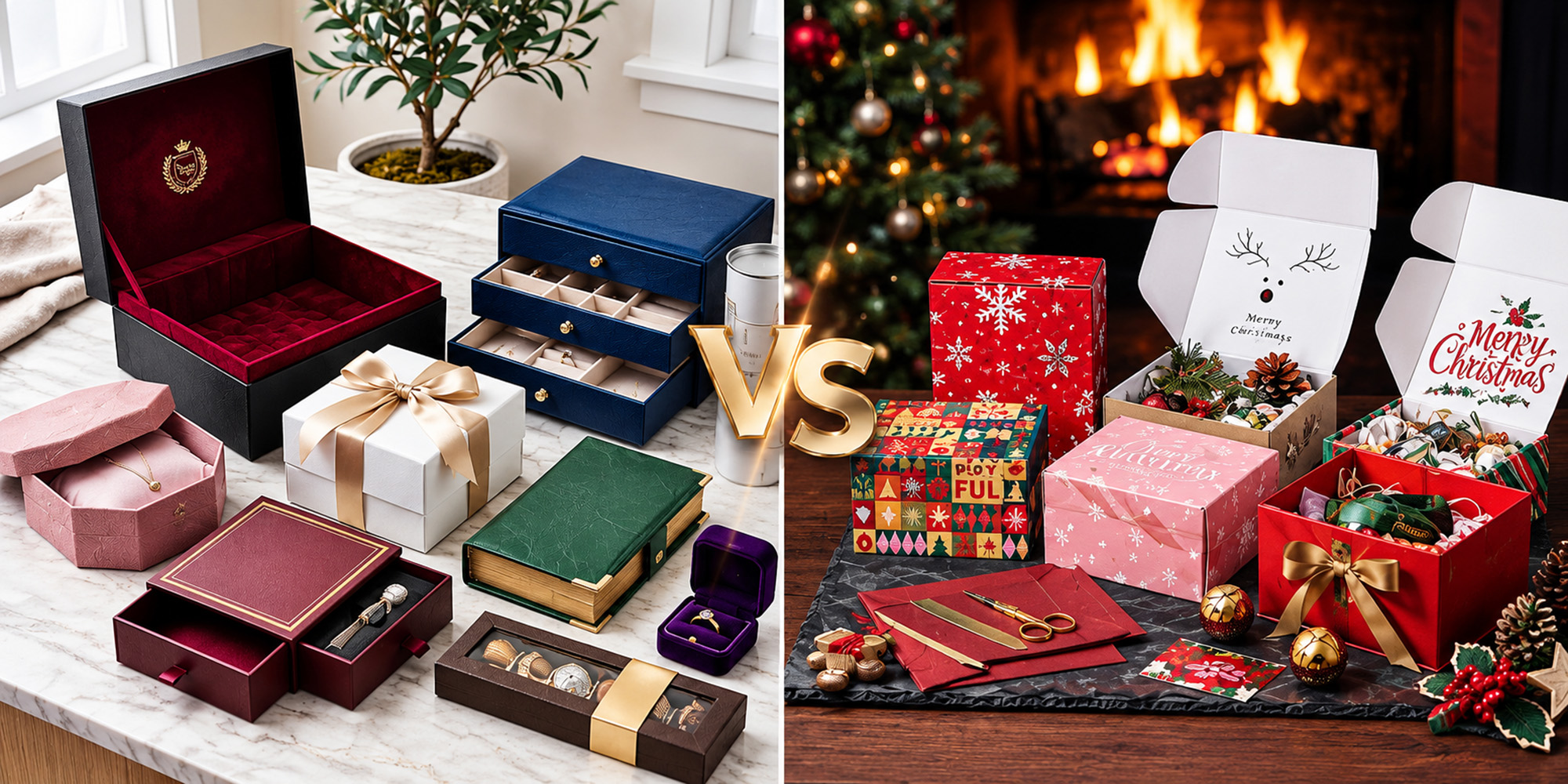
For most Christmas ranges, the right choice breaks down by product, not preference – rigid boxes suit items customers keep (jewelry, cosmetics, premium spirits); folding cartons suit everything higher-volume or lower-priced. Rigid boxes typically need ordering by mid-September to early October for full customization; folding cartons have more room since digital print skips the plate-making delay.
If you’re weighing which one to choose for this year’s range, the order-by date is closer than the calendar suggests.
This guide covers:
- The real construction and cost distinction between the two formats
- Five standard Christmas product types matched against the right choice
- An under-covered compliance angle for 2026
- The US production deadline you’re working against right now
The Real Difference, Beyond Premium vs. Cheap
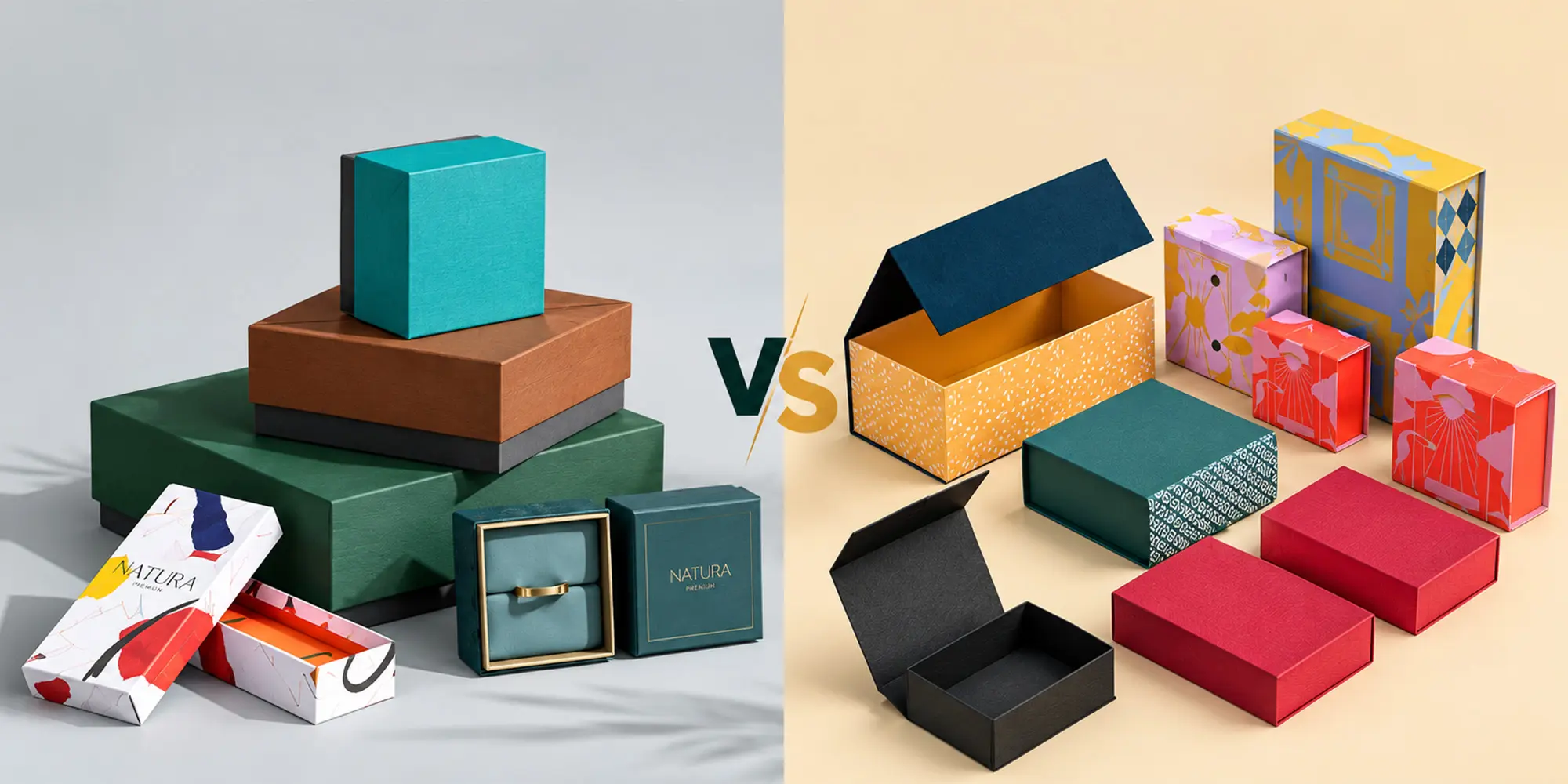
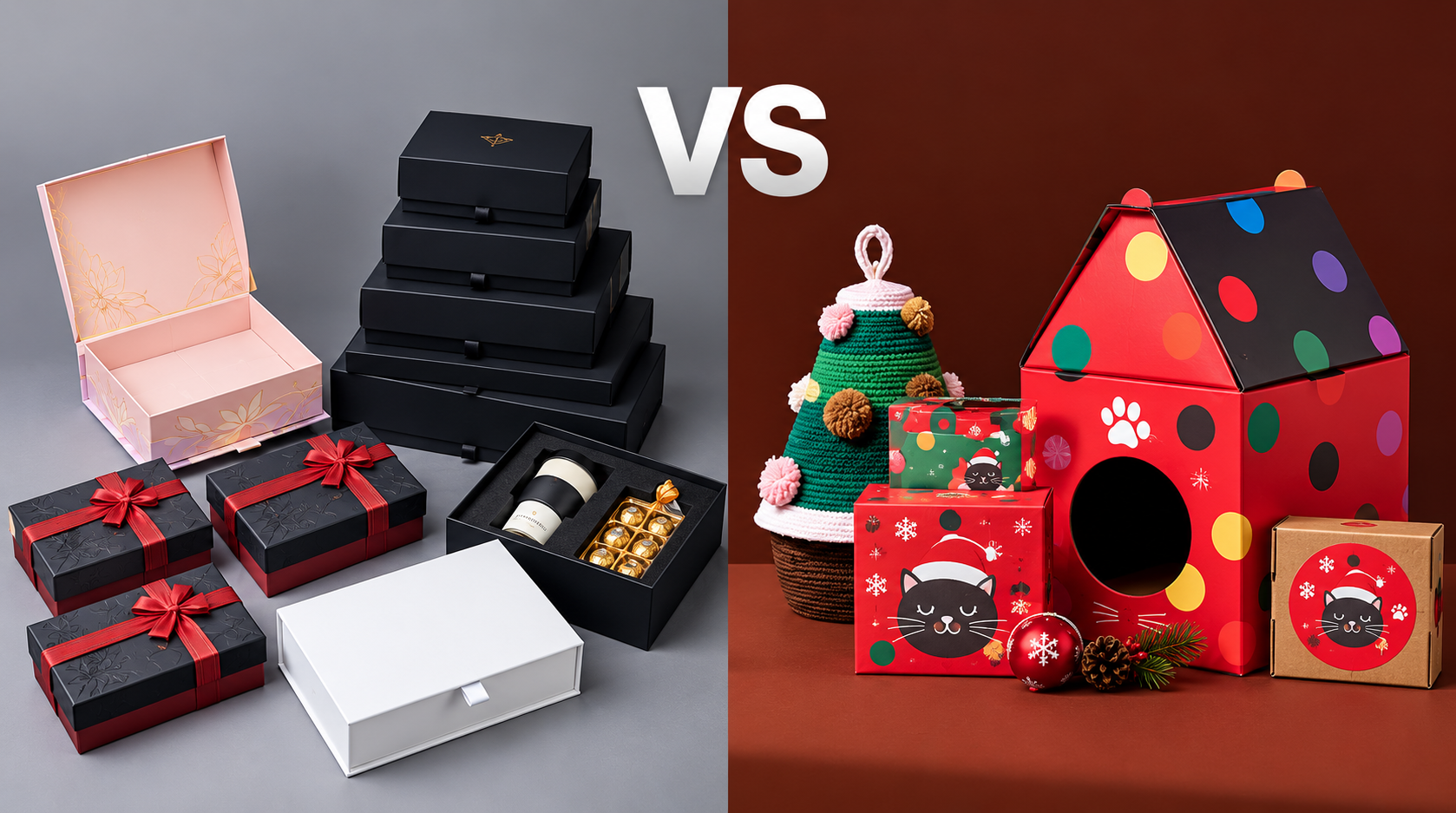
A rigid gift box is constructed from greyboard or chipboard, 1.2mm to 2.2mm depending on size and closure type, covered in printed or decorative paper. It’s assembled permanently at the factory and doesn’t fold flat, which gives it that weighted, substantial feel when a customer lifts the lid – the construction behind our own Rigid Gift Boxes UK range.
A folding carton is produced from lighter SBS or FBB board, 280 to 400gsm, die-cut and scored so it folds flat and is erected at the point of packing.
How does a rigid gift box’s cost compare to a folding carton? The table below covers most of that price distinction before a single finish is added.
| Attribute | Rigid Gift Box | Folding Carton |
| Board thickness | 1.2mm-2.2mm+ greyboard/chipboard | 280-400gsm SBS/FBB |
| Ships | Assembled, takes full volume | Flat, erected on use |
| Typical US MOQ | 100-500 units | 500+ units for best pricing |
| Standard lead time | 7-10 working days post-approval | Often faster, especially digital print |
| Reused by customer | Common | Rare |
Why Rigid Print Looks Different, Not Just Thicker
There’s a technical reason rigid boxes photograph better than a simple “it’s sturdier” explanation suggests. A folding carton has to be scored and creased so it folds flat, and that crease line puts real stress on whatever’s printed or foiled across it, sometimes producing a faint crack or dulling right at the fold. A rigid box’s decorative wrap is applied to a board that never flexes after assembly, so foil stamping, embossing, and fine detail print stay smooth edge to edge with no crease to interrupt them – a real reason rigid earns its premium on close-up product photography, separate from the weight and durability argument.
Construction Styles: More Than Just Rigid or Folding
The rigid-versus-folding decision usually gets made before the style decision, but style affects both cost and the unboxing sequence just as much as material does.
| Rigid Box Style | How It Opens | Typical Christmas Use |
| Lid-off two-piece | Separate lid lifts fully away | Classic gift sets, apparel |
| Hinged/magnetic closure lid | Lid stays attached, magnetic pull closure | Cosmetics, jewelry, and gifts |
| Drawer and sliding tray | Inner tray slides from outer sleeve | Premium cosmetics, watches, spirits |
| Shoulder-and-neck | Lid lifts off a raised inner shoulder | Perfume, wine, collectible gifts |
| Book-style | Opens like a book, magnetic or ribbon closure | Jewelry, stationery gift sets |
| Folding Carton Style | How It Closes | Typical Christmas Use |
| Reverse tuck end | Top and bottom flaps fold opposite directions | General retail confectionery |
| Straight tuck end | Top and bottom flaps fold in the same direction | Everyday retail cartons |
| Auto-lock bottom | Base flaps fold and lock automatically | High-speed retail packing lines |
| Gable or window | Carry handle or die-cut viewing window | Retail candy, visible-product ranges |
How Storage and Transport Affect the Decision
Does storage space change which format makes sense? For a seasonal range you’re stocking for six to eight weeks, storage is usually the deciding factor before cost or production even enter the discussion. Folding cartons ship and store flat until needed, so a warehouse can hold several months of Christmas stock in a fraction of the footprint a rigid box run takes up. Rigid boxes arrive pre-assembled and occupy their full volume from delivery through to the moment the product goes in.
That difference shows up in freight cost before a single unit reaches the customer. A pallet of flat folding cartons holds several times more units than the same pallet space filled with completed rigid boxes, so inbound freight and storage racking costs both favor folding cartons at any meaningful volume.
What MOQ do I need for a custom rigid box vs. a folding carton? Volume answers part of that question, but available storage space usually answers it first.
Five Christmas Products, Five Different Answers
It depends less on whether it’s Christmas packaging and more on what’s inside. Here’s how the decision plays out across five categories that make up most seasonal US gift ranges.
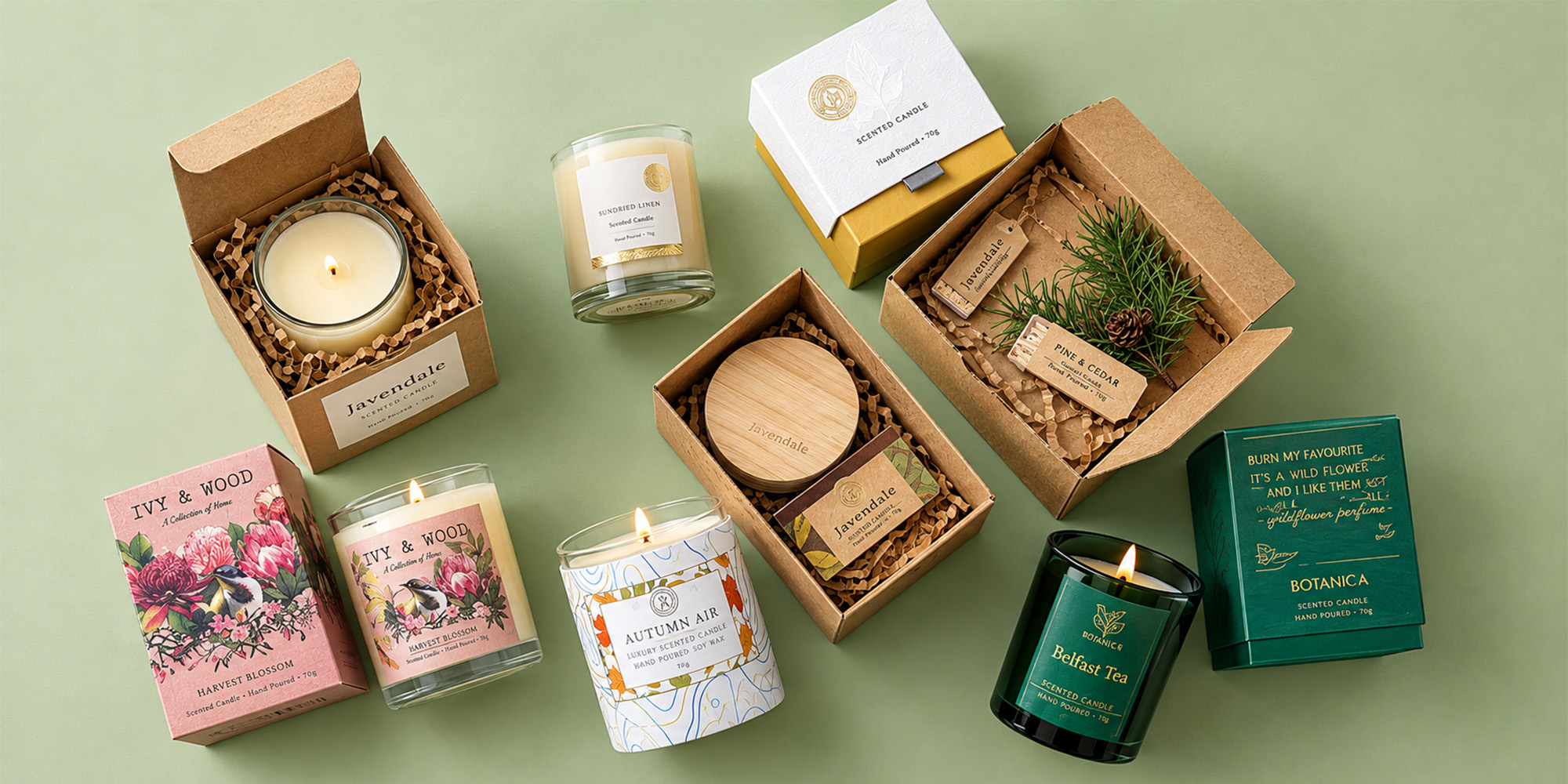
Candles. A single-wick jar candle at 200-350g and a midrange price point sits in contested territory. If it’s part of a gifting range above roughly $18-25, a rigid box with a fitted divider earns its keep – pairing well with a candle gift set. Below that, a nicely specified folding carton with a corrugated shipper does the protective job without the price jump, especially for a reusable jar candle box meant to be kept. Rigid for gift-set candles, folding carton with a divider for everyday single jars.
Chocolates and confectionery. Weight is low, and volume is usually high, which is exactly where folding cartons make sense. Rigid boxes suit a formal corporate chocolate gift collection, but a standard festive assortment of individually wrapped chocolate bars sold through retail rarely needs the extra structure, and the added storage footprint of assembled rigid boxes is a real cost for a seasonal SKU you’re only stocking for eight weeks.
Jewelry and accessories. High value, low weight, and usually fragile. This is closest to a default rigid category, since the structural protection and the perceived value both matter, and the box itself often gets kept. Rigid, nearly without exception.
Spirits and wine. Weight and breakage risk are both high, which folding cartons alone don’t handle well without a corrugated outer for shipping. A rigid shoulder-and-neck box works for retail and in-store gifting; for direct-to-consumer shipping, a folding carton with a fitted corrugated shipper is often more practical, since a rigid box needs an outer for transport either way. Rigid for retail/in-store, folding carton plus corrugated shipper for DTC transport.
Skincare and cosmetics. This is the category where the unboxing moment holds the most weight, since it’s the one likely to end up on social media. A rigid magnetic closure box at 1.8- 2.2 mm explains itself here even at a mid-range price point, because the reveal is doing marketing work a folding carton can’t duplicate. Rigid, unless the range is priced as a value stocking-filler.
Retail Shelf vs. Direct-to-Consumer: Matching Format to Channel
Does rigid make more sense for retail or for online orders? Channel context changes the calculus more than most Christmas packaging guides admit. The format that wins in a specialty retail environment isn’t automatically the one that wins in a DTC unboxing sequence, and the reverse is just as true.
Rigid boxes perform best for:
- Gift retail settings where the box itself is part of the perceived value of the purchase
- Countertop or open-shelf luxury displays where the packaging doubles as a product fixture – a common ask for fragrance oil and attar-style boxes used in-store
- High-ticket DTC products where the unboxing moment is a calculated, planned brand experience
- Fragrance, cosmetics, and premium electronics, where the packaging itself signals the price tier before the product is seen
Folding cartons perform best for:
- High-velocity retail SKUs that need to hit a competitive shelf price point
- Multi-item subscription box inserts, where several items travel together inside one outer box
- Brands that reorder frequently through the season and need the warehousing efficiency flat-pack storage gives them
- Ranges where the folding carton is a secondary layer, and the product itself is doing the premium work, not the box
The decision maps cleanly to price point and purchase context instead of product category alone. If the customer is paying a premium price and expects the packaging to reflect that, a rigid box earns its added cost. If the purchase is functional at a competitive price and the packaging is a baseline expectation instead of a selling point, a well-executed folding carton, paired with a Custom Corrugated Boxes UK-style shipper where required, is the smarter call.
US carriers increasingly price by dimensional weight as much as exact weight, which matters more for rigid boxes than it first appears. A box built for shelf presence and gift weight can cost more to ship than its actual weight would suggest, simply because it occupies more volume in transport than a flat-packed folding carton ever does before assembly.
Cost-to-Value Ratio: What You’re Honestly Paying For
The price gap is structural, not arbitrary. Chipboard is heavier than the paperboard used in folding cartons, so the base material costs more before anything is printed on it. Permanent assembly brings more production time and material overlap than a die-cut, scored carton that erects itself in seconds. And because a rigid box never folds flat, it costs more to ship at every stage of its life – factory to storage to customer – simply because it always occupies its full volume.
None of that answers whether rigid boxes are worth the extra spend, only why they cost more in the first place.
Is a rigid box worth it for a mid-range product? The question is whether the price difference produces a return in your specific channel and price point. A cosmetics or jewelry line selling at a real premium in specialty retail usually gets that return, because the box is part of why the customer accepts the price. A mid-range product moving through high-volume retail rarely sees a proportional lift from the same spend, and that budget is often better redirected toward a heavier board weight and better finish on a folding carton instead.
What It Actually Costs at US Volumes
| Format | Approx. US Cost | Typical Volume Band |
| Folding carton, plain/lightly printed | $0.45-$1.10/unit | 500+ units |
| Rigid box, standard finish | $2.75-$3.75/unit | 500-1,000 units |
| Rigid box, low volume or first order | Up to $6.50/unit | ~50 units |
| Foil stamping/embossing add-on | $0.90-$2.00/unit | Plus one-off tooling $100-$200 |
These are general 2026 US market ranges, not a quote – confirm exact figures against your specific spec, since board and freight costs shift with volume and material sourcing.
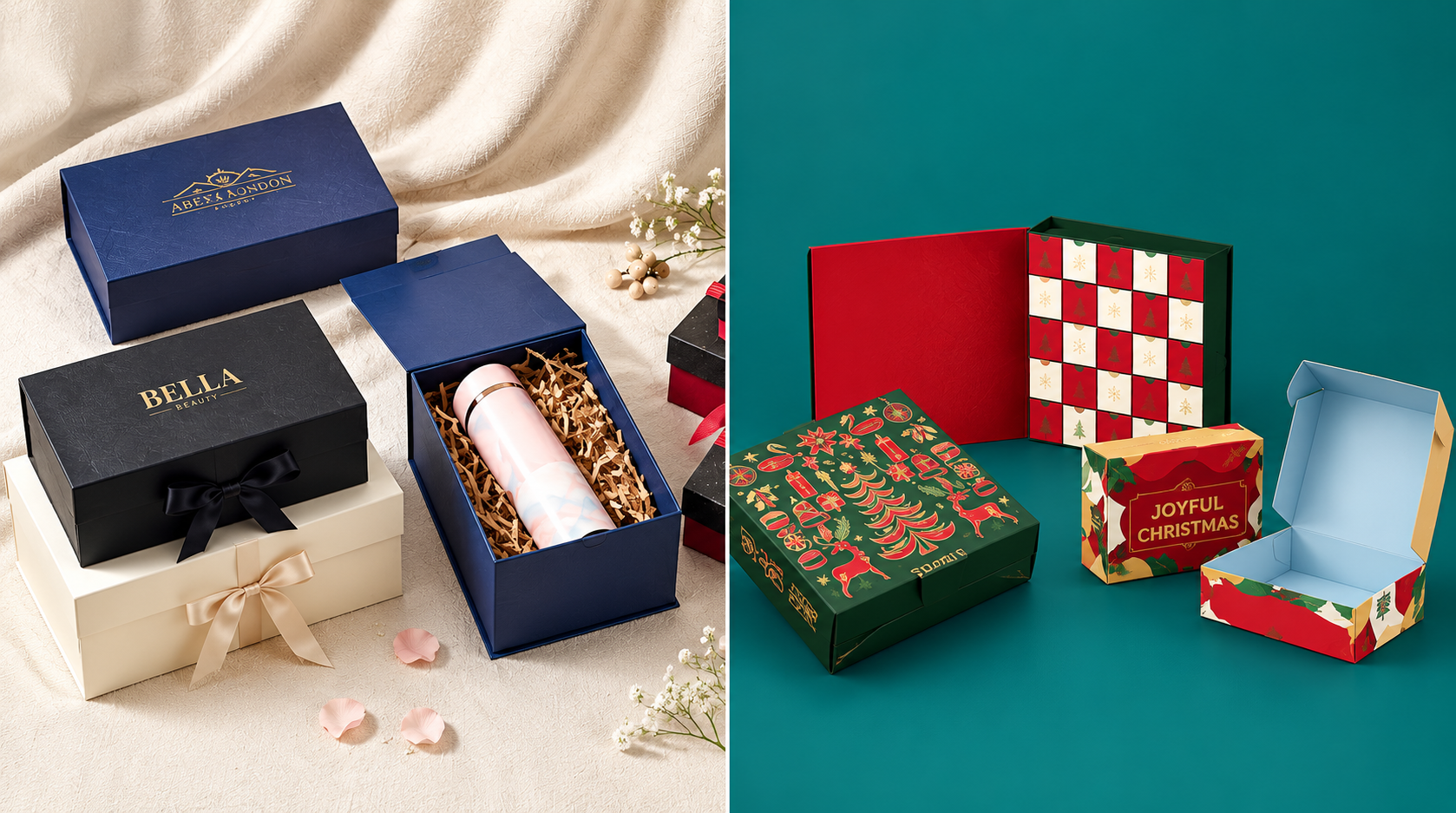
Can a Folding Carton Ever Feel as Premium as Rigid?
A heavier board weight, a full-coverage soft-touch laminate, and tight closure tolerances close a real amount of the gap, especially once the product is sealed inside secondary packaging and the customer isn’t comparing the two side by side.
Folding cartons also get easier access to a direct water-based varnish finish, since a rigid box’s decorative surface is pre-printed paper glued onto the board instead of printed after assembly. Some rigid suppliers do offer varnish on the wrap paper itself first, so it isn’t strictly unavailable on rigid – but it’s a more roundabout route than the single-pass finish a carton gets.
Is a folding carton good enough for Christmas gifting? For most price points below the premium tier, yes – particularly once board weight and finish are specified properly instead of defaulted to the cheapest option available. An eco-friendly or Certified stock closes even more of the perceived gap for brands where sustainability is already part of the story.
Material choice carries a separate compliance angle worth knowing for 2026: seven US states have now passed their own Extended Producer Responsibility (EPR) packaging fee laws (Oregon, Colorado, California, Maine, and Minnesota among the first), which can add real cost to a plastic component in a gift box – a window, a ribbon, a closure mechanism – even where the box itself is paper-based. Neither of these facts makes a rigid box the wrong choice for a Christmas range. They do mean the finish and closure spec, not just the board itself, belongs in the cost conversation before you commit to a print run. Check the specific states you’re shipping into, since EPR fee structures vary by state.
When Do I Need to Order Christmas Packaging By?
Factoring in artwork rounds and a realistic single-approver timeline, suppliers commonly advise placing Christmas rigid box orders by mid-September to early October to guarantee delivery with room left to fill and ship before the season itself – consistent with the general 10-12 week safe window we cover in our Christmas gift box ordering timeline, with rigid boxes specifically benefiting from the earlier end of that range given their longer tooling and assembly requirements.
An illustrative pattern, not a single verified case: gifting packaging suppliers regularly see this exact gap catch out brands every year – the calendar says there’s time, the production schedule says otherwise.
If today’s date has already passed that point, a folding carton run is usually the faster route back to on-shelf timing, since digital print carries no plate-making delay and short runs can often move faster through production than a rigid box with a first-time tooling requirement.
If you haven’t confirmed your supplier yet and Christmas rigid is still the goal, treat this week as the deadline, not a guideline.
How to Select the Right Format for Your Range
Once the numbers and the deadlines are in front of you, the decision comes down to four practical checks instead of a gut instinct about which format looks nicer.
Product safety first. Whatever else the box does, it has to deliver the product to the customer intact. A fragile or high-value item settles the format question before branding or budget even come into it.
Sustainability should match what you’re already claiming. A brand built on low-impact, natural positioning fits comfortably with a mono-material folding carton, not a laminated or magnet-fitted rigid box – the packaging should back up the claim instead of undercutting it.
Convenience matters as much as presentation. A product bought for practical, everyday use doesn’t require a rigid box’s ceremony, and forcing one on it can read as excessive instead of premium. Save the rigid spec for products where a slower, more deliberate opening genuinely adds to the experience.
Look at the total price, not the packaging line item alone. A customer buying a gift doesn’t separate the two figures in their head – they see one item. Spending heavily on presentation for a mid-price product can make the whole purchase look overpriced instead of premium, which works against the box instead of for it.
Questions Worth Asking Before You Commit
Is the box getting kept, or opened once and binned? If it’s being kept, rigid earns its cost more easily. If it’s binned same-day, that cost is harder to justify on protection alone.
Does my closure or finish push this into a different EPR fee bracket? A magnetic closure or laminated wrap is worth checking against a plain water-based-print folding carton before the spec is locked, depending on the states you ship into.
Do I actually have until Christmas week, or until mid-September? The gap between those two dates is where most seasonal packaging orders go wrong.
Conclusion
There isn’t a single right answer between rigid gift boxes and folding cartons for Christmas, only a right answer per product line. High-value, keepable, fragile, or social-moment-driven items lean rigid. Higher-volume, lower-price, or shipping-heavy lines lean folding carton, especially once a well-specified board weight and finish close most of the perceived gap. What decides it, more often than the board itself, is whether your supplier can still hit Christmas at all by the time you brief them.
Written by the Hale Path Packaging team, packaging specialists with over a decade of experience supplying both rigid and folding-carton gift packaging for holiday ranges across the USA. This guide reflects the construction, cost, and timeline factors Hale Path controls directly – actual search visibility also depends on factors outside this article, including domain authority, technical site health, and indexing time.