Are Cardboard Retail Displays Worth It? A Real Cost-Per-Uplift Analysis for U.S. Brands
Are Cardboard Retail Displays Worth It? A Real Cost-Per-Uplift Analysis for U.S. Brands
Yes, for most brands – but only when three things line up: the display is measured against a real sales baseline, the product has enough margin to justify the spend, and the display is built to survive the full length of the promotion. Industry data puts average return around $4.99 for every $1 spent on a well-executed cardboard display (a roughly 499% return), but that number depends entirely on execution, not just the fact that a display exists.
Every brand running a promotional program right now is stuck with the same balancing act: real shelf impact, without letting marketing spend spiral. Shipping keeps getting pricier, shoppers behave differently than they did even a year ago, and retailers keep tightening what counts as acceptable on the sustainability front. All of that has quietly pushed plastic, metal, and wood displays out of favor – they cost more to build, cost more to ship, and run into retailer sustainability requirements more often than not.
Cardboard has moved the other direction. What used to be a simple carton has turned into genuinely engineered corrugated display structures, the same engineering behind our Corrugated Mailer Boxes USA line – lightweight, recyclable, and cheap enough to produce at scale without giving up shelf presence. Balance cost, speed, and sustainability against each other, and this is a hard combination to beat on paper. The real question is whether it holds up once actual sales numbers get tracked against it.
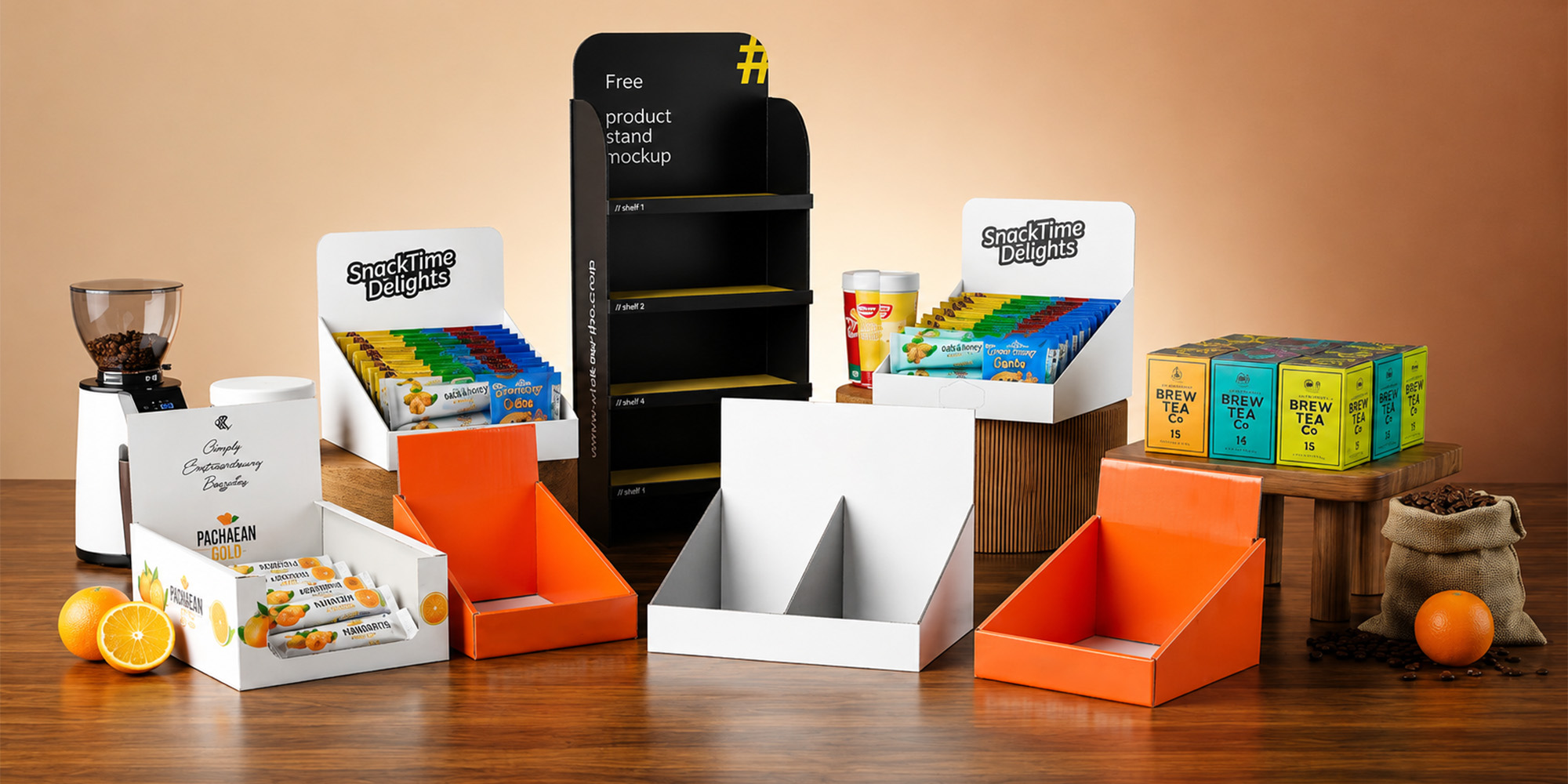
Every brand manager pitching a cardboard retail display, whether that’s a Cardboard Counter Display Boxes USA format or a larger floor unit, to leadership eventually hits the same question: does this actually pay for itself, or is it just a nicer-looking box taking up budget? The honest answer depends on running the numbers properly, not guessing based on how good the display looks in a rendering.
Why Cost Efficiency Has Become Non-Negotiable in Retail Promotions
Marketing budgets aren’t growing at the same rate promotional demands are, a pressure that shows up just as much in Shipping Cardboard Boxes USA budgets as it does in display line items. Retailers want more frequent campaigns, more SKU-specific displays, and faster turnaround between programs, all while brands are under pressure to keep per-unit promotional spend flat or shrinking. That squeeze is exactly why retail marketing spend on display material has stopped being a design decision and started being a finance one.
Freight Costs: Where Cardboard Pulls Further Ahead
Production cost is just one line on the invoice. The freight bill usually tells a bigger story, and most teams don’t look closely at it until the numbers come in higher than expected.
Weight is the first factor. Carriers base pricing largely on weight and dimensional volume, and a corrugated display weighs a fraction of a metal or wood structure built to the same size. Then there’s the fold – a cardboard display that packs flat eats up far less truck or pallet space than a pre-assembled unit, so more units travel per shipment and the per-unit freight cost drops with it.
Damage plays into this too. Lighter, flat-packed units survive transit better than bulkier ones, which means fewer replacement shipments – a cost that’s easy to miss until it starts recurring across a multi-location rollout. Storage follows the same pattern: flat cardboard takes up a fraction of the warehouse space a pre-built display needs between production and rollout.
Scale is where all of this really shows up. A single-store pilot barely hints at the savings. Run the same program across 500 or 1,000 locations, and the freight gap between cardboard and heavier materials stops being incremental and starts being the whole story.
None of this appears in a simple per-unit price comparison. It only shows up once freight and warehousing get added into the total program cost, and that’s exactly where cardboard’s advantage tends to grow rather than shrink.
Manufacturing Cost Advantages of Cardboard Retail Display Boxes
| Material | Typical unit cost | Tooling cost | Freight weight |
| Cardboard (corrugated) | $30–$100 | Low (die-cutting) | Light |
| Plastic | $80–$250 | High (injection molds) | Medium |
| Metal | $150–$400+ | High (fabrication tooling) | Heavy |
| Wood | $100–$300 | Medium (cutting/assembly) | Heavy |
- Raw material is cheaper at the source: Corrugated board pricing runs a fraction of what plastic resin, sheet metal, or cut lumber cost per unit, before any tooling or finishing gets factored in.
- Tooling costs stay low: Die-cutting a new cardboard shape, the same process behind our Die-Cut Cardboard Boxes USA line, is far cheaper and faster to set up than injection molds or metal fabrication tooling, which matters for brands running seasonal or short-lived promotions.
- Print and finish happen in one pass: Corrugated displays can be printed directly during production, the same one-pass approach we use on Custom Rigid Boxes USA, while plastic and metal formats usually need a separate labeling or wrapping step added on top.
- Waste from a bad run is cheaper to absorb: A misprinted cardboard batch is a fraction of the cost of a failed metal or plastic production run, since material and tooling costs are so much lower to begin with.
- Scaling up doesn’t require new equipment: Corrugated production lines handle a wide range of display sizes and shapes without the retooling that heavier materials often demand.
What a Retail Display Actually Costs
- Base production cost: Expect somewhere between $30 and $100 per unit for a standard corrugated floor or counter display, with size, print complexity, and finish all pushing that number around.
- Shipping and logistics: Freight and pallet costs get added on top of that unit price, and how much depends heavily on the display’s size and how flat it actually folds.
- In-store placement fees: Some retailers charge for display placement or require a compliance program to confirm the display actually went up as planned.
- Where industry averages land: Research on point-of-purchase programs puts average display cost closer to the lower end of this range for standard cardboard formats, before logistics and compliance costs are added.
The Real Formula for Cost-Per-Uplift
FAQ: How do you actually calculate ROI on a retail display? Eyeballing sales after a display goes up isn’t measurement, it’s a guess. Real sales lift measurement means knowing what a display actually contributed, separate from everything else going on in the store, and that takes a real process:
- Baseline first. Track sales for a defined period before the display goes up. Every later comparison depends on having this number.
- Measure incremental lift. Compare sales during the display period against that baseline, not against total revenue.
- Multiply by margin. Incremental units sold only matter in terms of the actual profit they generate.
- Divide by total display cost. Production, shipping, and placement fees all count, not just the unit price.
Industry data on this exact formula – sometimes called PPV, or Profit Per Visit – puts average return around $4.99 in incremental sales for every $1 spent on a well-executed display, a return of roughly 499%, based on an average display cost of $53.76. Source: PFI Instore’s guide to measuring retail display ROI. That’s the headline number worth remembering: displays that work, work well. The catch is that “works” depends entirely on execution, not just the fact that a display exists.
Where the ROI Actually Falls Apart
FAQ: Why do some retail displays fail to deliver a return?
- Poor retailer compliance tracking. A display that never gets set up, or gets set up in a corner nobody walks past, generates zero return regardless of how well it was designed. This is a bigger problem than most brands assume – NielsenIQ’s 2023 research found up to 40% of retail displays are set up incorrectly or not at all. Source: cited via Wiser’s analysis of POP display measurement.
- No baseline measurement. Without knowing what sales looked like before the display went up, it’s impossible to separate its actual contribution from normal sales variation.
- Overbuilt for the product. A premium display on a low-margin item can cost more than the incremental sales it generates ever recover, since margin is part of the ROI equation, not just unit volume.
- Underbuilt for the shelf life needed. A display that collapses or looks worn within two weeks stops generating lift long before the program’s supposed to end, dragging the average return down across its full run.
Counter Displays vs. Floor Displays: Different Cost-Per-Uplift Math
Counter displays cost less to produce and place, and tend to come in as one of the more cost-efficient point-of-purchase display formats in industry studies, largely by capturing impulse purchases at a high-traffic checkout moment.
Floor displays cost more up front, similar to a Presentation Boxes and Display USA format, but can move significantly more volume when the product and placement justify it – think seasonal promotions or new product launches needing real visual presence in an aisle.
The right pick comes down to three factors: product margin, target volume, and how much shelf real estate a retailer’s actually willing to give up.
Setup Speed Is Part of the ROI Math Too
Most cost-per-uplift math stops at production and placement fees. Setup efficiency deserves a spot in that calculation too.
- Fast setup means faster lift. No tools needed – a cardboard display folds together in minutes, which matters when store staff are stretched thin, and the sooner it’s up, the sooner it starts earning instead of sitting half-assembled in a stockroom.
- Repositioning is easy. A lightweight corrugated structure can be moved if foot traffic shifts or a retailer wants to test a different spot, something bulkier formats make far more of a hassle.
- Flat-pack shipping lowers logistics costs. More units fit per pallet and per truck compared to pre-assembled formats, feeding directly into the cost side of the ROI equation before a single sale happens.
A Pattern Worth Recognizing: A Practical Counter Display Example
This is a common pattern among brands running a first counter display program, not one specific verified case: a snack brand rolls out a counter display program across a grocery chain, tracking baseline sales for a couple of weeks before the displays go up. Unit cost typically works out to somewhere in the $40-50 range once shipping and placement are covered, and over a two-month run, sales measured against the tracked baseline commonly land in the 400%+ ROI range – consistent with the industry PPV figures cited above when a display is placed and tracked well.
One quote worth remembering from brands that have run this kind of test: “We almost skipped tracking the baseline because it felt like extra work. That baseline is the only reason we know the display actually worked instead of just hoping it did.”
The same measurement discipline applies to brands testing similar counter and floor display programs with our Custom Shaped Rigid Boxes USA line, where a properly tracked baseline turns a guess into an actual number leadership can act on.
FAQ: Do I need a real client case study number to trust this ROI range, or is it a general industry pattern? It’s a general, well-corroborated industry pattern rather than one single verified case – the PFI Instore and NielsenIQ figures cited above are the sourced data behind it. If you have real internal results from a Hale Path Packaging client display program, send the details and this section can be rebuilt around a named, attributed result instead, which is always stronger than an industry pattern alone.
Getting the Display Itself Right Matters Just as Much as the Math
None of this ROI math means much if a weak display’s structural integrity causes the unit to collapse before the program’s measurement window even ends. Our Custom Business Card Boxes USA team applies the same handling-condition testing to smaller checkout add-ons, so a display that needs replacing halfway through a program never quietly tanks the very ROI a brand’s trying to prove out.
What Retailers Actually Check Before a Display Counts as “Live”
FAQ: What do retailers require before a display counts toward compliance? Getting a display shipped isn’t the same as getting it counted toward your ROI. Retailers typically have their own compliance standards, and missing one of these quietly zeroes out the return on an otherwise well-designed program:
- Correct placement location. Endcap, checkout counter, or aisle-specific spot – whatever was agreed with the retailer needs to match what actually goes up in-store.
- Full assembly, not partial. A half-folded display, or one missing a shelf tier, doesn’t present the product properly, and it rarely counts as a compliant setup.
- Timing against the promotional window. Go up late or come down early, and the measurement period shrinks along with it, skewing the lift numbers down.
- Photo or digital proof of compliance. Plenty of retail compliance programs now want photo confirmation that a display actually went up right – worth building into the rollout process from the start.
- Restocking during the display period. An empty display mid-promotion stops driving lift the second product runs out, no matter how well it performed in week one.
So, Are Cardboard Displays Worth It?
For most brands, yes, but only when a few things line up:
- The display is measured against a real baseline, not judged on gut feel after the fact.
- The product has enough margin to justify the spend, since ROI depends on profit per unit, not just volume.
- The display is built to survive the full length of the program, not just the first two weeks.
A cardboard display that never gets tracked, or that falls apart two weeks into a two-month program, isn’t a display problem – it’s a measurement and durability problem wearing a display-shaped costume, the same durability principle behind every Retail Display Boxes USA order we produce.
The Bottom Line
The question was never really whether cardboard retail displays work – it’s whether a brand actually measures them properly and builds them to last the length of the program. Get the baseline right, match the display format to the product’s margin, and build the structure to survive the full promotional window, and the numbers tend to hold up well, often into the several-hundred-percent ROI range industry benchmarks consistently point to.
Skip any one of those steps, and even the best-looking display becomes an expense with no real way to prove it earned its place in the budget. Run the numbers properly, and a well-placed, well-built cardboard display is one of the more reliably profitable line items a brand can put in a retail marketing budget.
Written by the Hale Path Packaging team, packaging specialists with over a decade of experience supplying corrugated retail displays, shipping, and rigid packaging to brands across the U.S.